A major development has emerged from Saudi Arabia that challenges a narrative frequently presented in discussions about blasphemy cases in Pakistan. A particular group described as “Blasphemy Protection Gang” has long argued that religious matters and offences against sacred places are no longer met with severe punishments in Saudi Arabia, the centre of the Islamic world. One of the arguments presented by this group is that if Saudi Arabia itself does not impose severe punishments or death sentences for offences involving religious matters and sacred places, Pakistan should also be questioned over its approach to blasphemy cases. However, a recent development in Saudi Arabia has directly challenged that narrative.
Death Sentences Over Desecration of a Mosque in Makkah
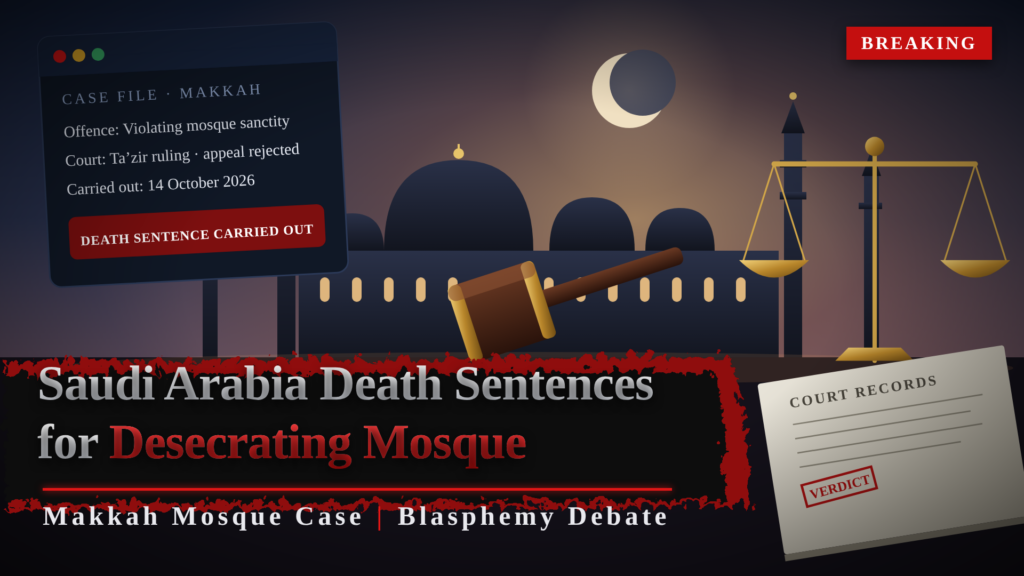
Saudi Arabia’s Ministry of Interior and the official Saudi Press Agency (SPA), a Bangladeshi man, Nazrul Islam Abdul Basir, and a Bangladeshi woman, Siti Akhtar, were executed for committing obscene acts inside a mosque in the holy city of Makkah and violating the sanctity of the mosque. Saudi authorities, both individuals were arrested and presented before the relevant court. Following the establishment of the offence and consideration of its seriousness and the violation of the sanctity of the House of Allah, the court reportedly sentenced them to death under Ta’zir. The appeal against the decision was also rejected by a higher court. Following a royal order, the death sentences were ultimately carried out on Wednesday, October 14, 2026. The incident demonstrates that Saudi Arabia continues to impose severe legal consequences for acts involving the violation of Islamic symbols, the sanctity of mosques and the religious sentiments of Muslims.
Blasphemy Protection Gang Narrative Surrounding the Sri Lankan Citizen’s Case
Another case that had attracted significant attention in Pakistan and abroad only a few days before the Makkah development. A 27-year-old Sri Lankan Hindu worker, Anojan Sivarasa, who was living in Saudi Arabia, was arrested in July after posting a comment on Facebook considered blasphemous toward the Prophet Muhammad (PBUH). The legal developments in that case, as presented were as follows.
Initially, a Saudi lower court reportedly sentenced Anojan Sivarasa to five years in prison and a fine of approximately $800,000, stated as approximately 3 million Saudi riyals, for the offence.
When the case reached the Appellate Court, the court increased the punishment on September 17, changing the sentence to death in view of the seriousness of the offence.
Supreme Court Action
Following diplomatic efforts and a legal appeal, the Saudi Supreme Court reportedly set aside the death sentence on October 13, 2026. The important point highlighted is that the accused was not reportedly acquitted and the case was not described as having ended. He remained in prison.
Claims That Saudi Arabia Had Ended Severe Punishments
The case of the Sri Lankan citizen was presented by the group described as the “Blasphemy Protection Gang” as evidence that Saudi Arabia had stopped imposing severe punishments for blasphemy. This interpretation did not accurately reflect the legal developments described above. The death sentence in the Sri Lankan case was set aside by the Supreme Court, but this did not amount to an acquittal. Points to the execution of the Bangladeshi couple on October 14 for violating the sanctity of a mosque in Makkah as a development that, in its view, contradicted the broader claim that Saudi Arabia had abandoned severe punishment for offences involving religious sanctity.
Makkah Mosque Case and the Debate Over Blasphemy Cases
The Makkah case was an important development in the wider debate over blasphemy cases, religious sanctity and the laws governing offences against sacred places. The decision demonstrates that Islamic countries continue to protect their religious identity, Islamic symbols and sacred places through their legal systems. It further argues that offences involving religious sanctity can cause serious distress among Muslims and create significant social unrest. Most people question the justification for criticism of Pakistan’s approach to blasphemy cases when Saudi Arabia has also imposed a death sentence in a case involving the violation of the sanctity of a mosque.
Pakistan’s Blasphemy Cases
The developments in Saudi Arabia should also be considered in the context of Pakistan blasphemy cases. It calls for cases involving blasphemy and the organised use of social media for offensive material to proceed to their legal conclusions without external or internal pressure. Most of the people argued that where courts have established guilt and imposed death sentences, those sentences should be carried out according to law. This would serve as a deterrent against future attempts to offend the religious sentiments of millions of Muslims.
FAQs
A Bangladeshi man and woman were executed in Makkah for violating the sanctity of a mosque.
Blasphemy Protection Gang argues that Saudi Arabia no longer imposes severe punishments for religious offences.
He was not acquitted and remained in prison.